What a day actually looks like
No philosophy in this one. Just the mechanics: what arrives, when, how long it takes, and what happens if you miss one.
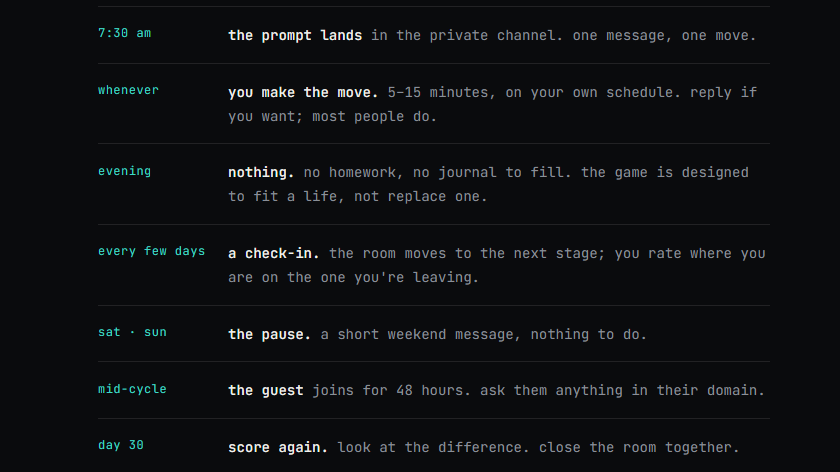
The Catalyst Game is a 30-day guided program that runs in a small private group. This is a plain walk through how it actually works, because the most common question we get isn't why, it's what will I be doing every day?
Before it starts
After you purchase a seat you get the Operator's Manual. It's your player-facing guide: what the seven domains are, what the rules of play are, and how the game is scored. Read it before day one. There's a short run-up of a few days before the 30-day clock starts, where the group meets, you take your baseline, and everyone gets oriented. After that opening, nothing you work on has to be shared with the group. The room is there so you aren't doing this alone, not so you have to perform.
The daily move
Every weekday morning one prompt arrives in the private channel. It's short, specific, and written to be done in minutes, not hours. It might ask you to notice something, change one small setting, or take one deliberate action. The prompts are playful on the surface and deliberate underneath; you'll see the pattern once you're a week in.
You do the move. That's the day. Some days you'll want to write a note to yourself about it; some days you won't. Both are fine.
Check-ins
Every few days the group moves from one domain to the next. That transition is a check-in. You rate yourself on the domain you're leaving, on a simple scale, and the number gets recorded. This isn't a test and no one else's number is compared to yours. It exists so that at the end you can see your own numbers move.
Weekends off
No prompts land on Saturday or Sunday. That's not a gap; it's part of the design. The weekday moves are small on purpose, and the weekends are where they settle. You'll get a short weekend message, but nothing to do.
The guest
Partway through the cycle, someone new joins the room for 48 hours: an expert in their field, there to answer questions inside their domain. You won't know who until they arrive. That's deliberate.
If you miss a day
You will, at some point. The game has rules, not punishments. The manual explains how to pick back up, and it's designed so that one missed day never becomes a reason to quit. Returning is the practice.
The end
On day 30 you score yourself again across everything the cycle covered, and you get to look at the difference between where you started and where you are. The group closes with a short celebration. What you do next is yours; the cycle is built to point back at your own life, not at the next thing to buy.
That's it. It's simpler than it sounds from the outside, and harder than it sounds from the inside, which is roughly the right balance for something meant to change you.